
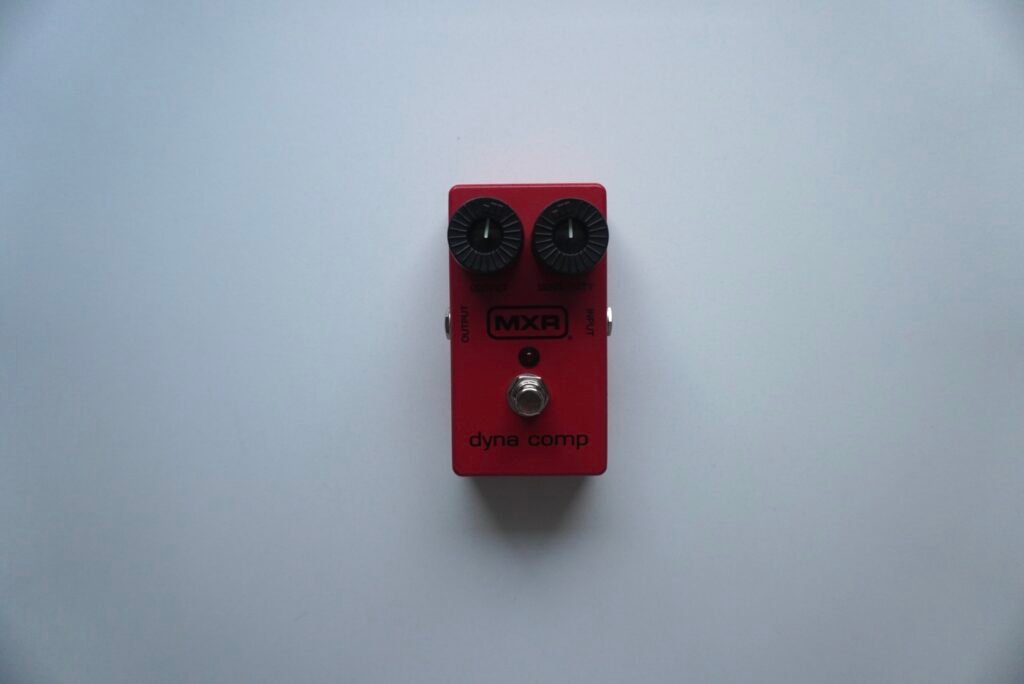
The Famous Red Box –
If you have spent any time looking at pedalboards over the last forty years, you have definitely seen that iconic little red box. The MXR Dyna Comp is easily one of the most popular compressors of all time, and for good reason. It is a Nashville staple, a classic rock essential, and for many of us, it was the very first compressor we ever added to our chain. It is simple, it is loud, and it does exactly what a compressor should do without any of that unnecessary boutique confusion.
The M102 is about as straightforward as gear gets. You get two knobs and a footswitch, and that is it. The Output knob controls your overall volume, which you can use to match your bypassed signal or even crank it for a massive clean boost. Then you have the Sensitivity knob, which is basically your “squash” control. This determines how much you are leveling out the signal and how much sustain you are adding to your notes. It is all housed in that classic MXR die cast metal that can clearly take a beating on the road, and it runs on a standard 9V power supply.
In the guitar community, everyone always talks about the Dyna Comp being “squishy” or “squashy.” What they really mean is that this pedal has a very fast, aggressive attack. As soon as you hit a note, the pedal grabs it and levels it out. Unlike those transparent studio compressors that try to hide the fact that they are even turned on, the Dyna Comp is proud of its character. It has a specific way of coloring your tone that adds a percussive, clicky snap to your picking. I personally don’t mind that squashed sound at all. In fact, I love it. Sometimes you don’t want subtle. You want to feel the compression working, and you can dime this pedal to get exactly the amount of sustain you need for those long, singing lead parts.
What really sets the Dyna Comp apart from other types of compression is the lack of “analysis paralysis.” Most modern compressors come with a handful of knobs for Attack, Release, and Ratio, which can be useful but also a total headache to dial in when you just want to play. The Dyna Comp uses a classic circuit that provides a very musical color. While an optical compressor is meant to be smooth and subtle, the Dyna Comp adds a bit of warmth and a slight midrange bump that helps a guitar cut right through a thick band mix.
At the end of the day, if you want a pedal that you can just stomp on and immediately hear that “classic” record sound, this is the one. It does not have all the bells and whistles of a three hundred dollar unit, but it has the soul and the history to back it up. Overall, definitely one to consider if you are in the market for simplicity.