
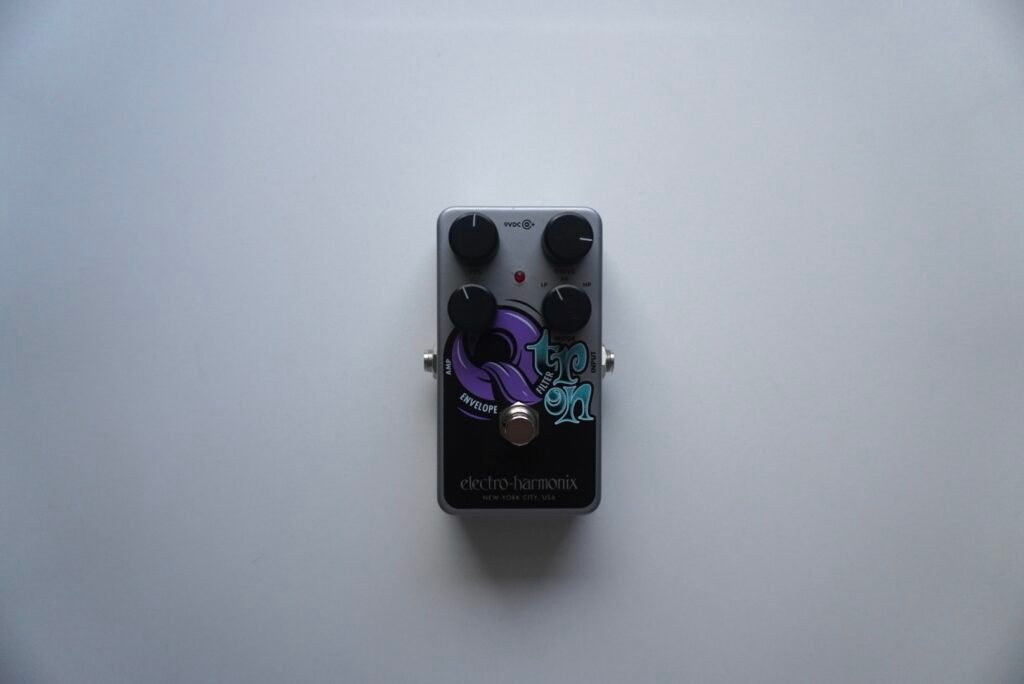
If you have ever spent a night down a YouTube rabbit hole watching 1977 Grateful Dead footage or a Phish 3.0 jam, you know the sound I’m talking about. It is that vocal, “quacky,” touch-sensitive filter that makes a guitar sound like it is breathing. For us jam band fans, the envelope filter is a must on the board.
The Garcia and Trey Factor
Jerry Garcia is the undisputed king of this sound, famously using the original Mu-Tron III. Trey Anastasio eventually followed suit, using it to add that growling, synth-like character to his leads.
The beauty of an envelope filter like the Nano Q-Tron is that it is dynamic. It reacts to how hard you pick. Play soft, and it stays mellow. Dig in and the filter “opens up” with a sharp, funky snap. To get the Jerry sound, you usually want to set it to the LP (Low Pass) or BP (Band Pass) mode and dial the drive until it triggers just right on your strongest pick attack.
Nano Q-Tron Specs
Despite the small footprint, EHX packed the essentials in:
- Mode Switch: Select between LP (Low Pass), BP (Band Pass), and HP (High Pass).
- Drive Control: This is your sensitivity knob. It determines how hard you have to hit the strings to make the filter sweep.
- Q Control: This adjusts the “peak” or the intensity of the filter. Higher settings mean more “quack.”
- Volume Knob: A massive upgrade over older versions, allowing you to match your volume when the effect is engaged.
- Power: Runs on a standard 9V DC center negative supply (only 10mA draw).
Nano vs. The Big Brother (Q-Tron+)
Now, I’ll be honest… I have actually never tried the full-sized Electro-Harmonix Q-Tron+. The main reason I went with the Nano was purely about pedalboard real estate. The Q-Tron+ is a total board hog, and it requires a specific 24V power supply, which is a headache if you’re using a standard power brick.
However, the community often points out a few key differences if you are deciding between the two:
- The FX Loop: The Q-Tron+ has an internal effects loop that lets you put a distortion or fuzz pedal between the preamp and filter section without messing up the envelope response.
- Sweep Direction: The bigger version has a switch to sweep the filter “Down” (making a “yawp” sound), whereas the Nano only sweeps “Up.”
- Response Switch: The Plus version has a Fast/Slow response toggle for more fine-tuning of the filter’s “bloom.”
Even without the extra bells and whistles of the big box version, the Nano Q-Tron is all I need as it does the thing. It delivers that “quacky” tone that defines the jam band sound without forcing you to buy a bigger pedalboard or a power adapter. If you want to nail those Mu-Tron style tones on a budget and save some space, this is the one.